- MORE ABOUT OUR NEWS
- CALL 412-882-8346

- ASK ABOUT LEASE-TO-OWN OPTIONS


Remote Start Confirmation: LCD vs LED Remotes
You press the remote start button, then what? If your remote only sends the command, you might not know whether your vehicle actually started until you head outside. And on a cold Pittsburgh morning, surprise! isn’t always the kind of excitement you’re after.
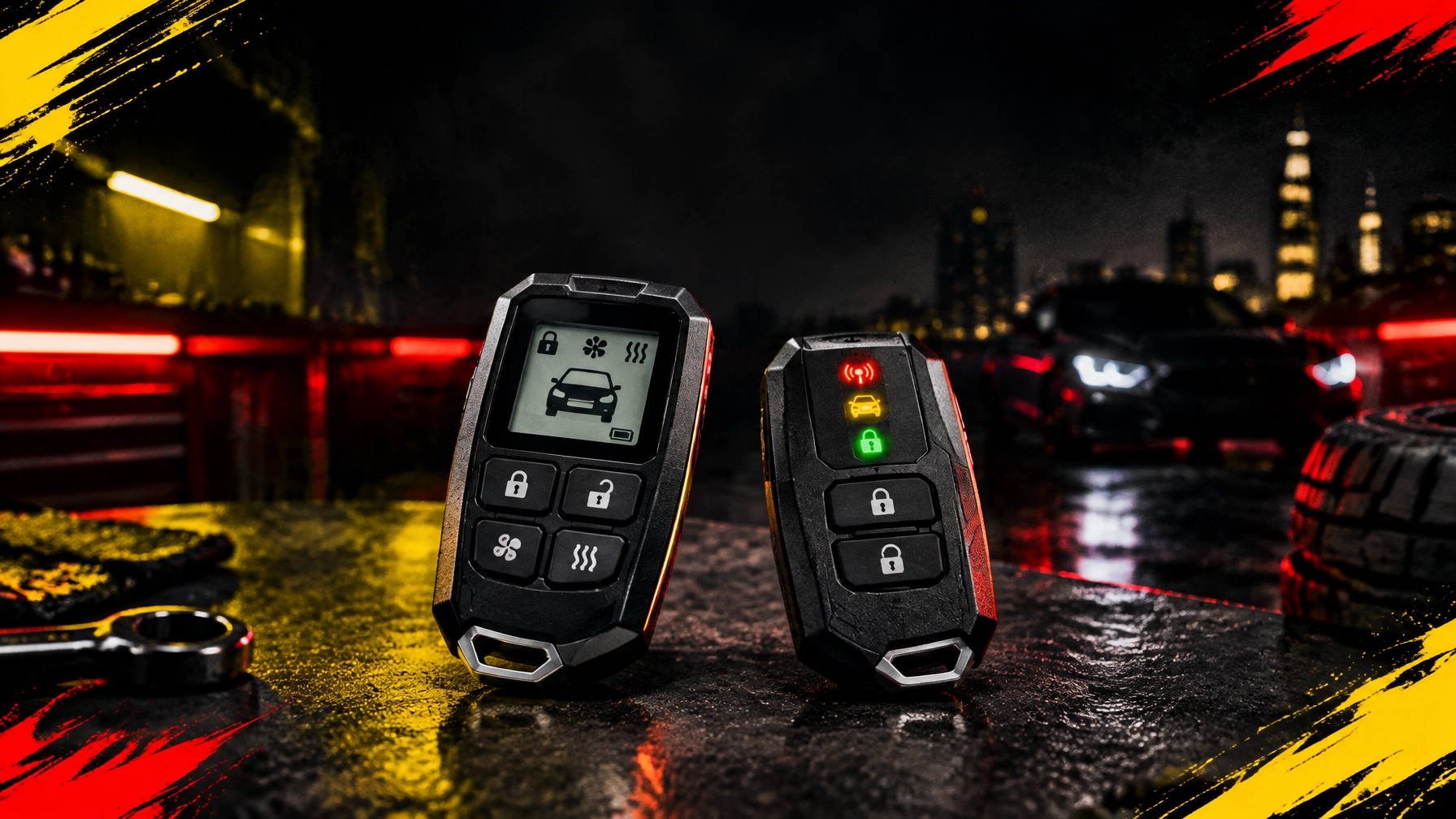
That’s where two-way confirmation comes in. A two-way system sends a signal back to your remote, using an LED indicator or an LCD screen to let you know your vehicle responded. Both styles do the important job: confirm the start worked. The difference is how they show you.
Let’s look at LED and LCD remotes, what you can expect from each, and how to pick the right fit for your vehicle and your routine. Warm in winter, cool in summer, and a little less guesswork all year!
We do these installs at 3287 Library Road (Route 88) in Castle Shannon, serving Pittsburgh's South Hills and beyond. If you're in Mt. Lebanon, Bethel Park, Upper St. Clair, Whitehall, Brentwood, Baldwin, Pleasant Hills, Dormont or Brookline, you're close. We also see plenty of drivers from Robinson, Cranberry, Monroeville and Canonsburg.
Why Remote Start Confirmation Matters
A one-way remote sends a command to your vehicle, but it doesn’t receive a reply. You press the button and hope the signal reached the vehicle and the start was successful. If it didn’t work, you may only find out when you walk out to a cold car. Not exactly ideal, huh?
A two-way remote changes that experience. It sends the command, then the vehicle sends a confirmation signal back to the remote. Depending on the system, you’ll see an indicator light or a message on a display. So you can check your remote instead of making an unnecessary trip outside.
That little bit of feedback can be especially useful when your vehicle is parked out of sight, like in a driveway around the corner, a busy lot, or a parking garage. Once you’re within the system’s effective range, distance stops mattering quite as much: you still get a clear signal that the vehicle responded. Just keep in mind that range is affected by conditions, including buildings, interference, and where you’re parked.
If you’re exploring options, take a look at Team Nutz’s remote starter systems. Our team can help you compare compatible options from Avital and Viper for your vehicle and day-to-day use.
LED Remotes: Compact, Simple Confirmation
An LED remote uses indicator lights to show you that the vehicle responded. It’s a straightforward approach: press the button, then look for the light pattern that confirms the command. The remote stays compact, and the status feedback is quick to read at a glance.

An LED remote may suit you if you like a smaller fob and don’t need a screen full of information. You can check for confirmation without navigating a display or interpreting extra details. Simple, tidy, and easy to keep handy.
The important thing is to understand what the indicators on your particular remote mean. Different models can signal confirmation in different ways, so your installer can walk you through the pattern and controls when the system is set up.
Think about how you’ll use the remote, too. Do you want a compact fob that’s easy to carry in a pocket? Are you mainly looking to know that your start command went through? An LED style may be the kind of no-fuss setup you’re after. And if you’re deciding between LED and LCD, remember: both can do the core job of confirming the start.
LCD Remotes: A Screen for Status
An LCD remote uses a small screen to show confirmation. Rather than relying on indicator lights alone, it can display status information about what the vehicle is doing. That can make it easier to check at a glance whether your vehicle responded to the command.

For example, Team Nutz offers a Viper two-way LCD four-button system with up to 2,000 feet of range. The system includes two remotes, one two-way and one one-way, plus an alarm. Optional horn output and Viper SmartStart compatibility are available. As with any remote range, actual performance varies with conditions, so treat “up to” as a stated maximum, not a guarantee for every parking spot.
An LCD can be a good match if you like seeing status on a screen instead of checking a light pattern. Consider whether you’ll regularly use the extra display information, or if you prefer to keep the remote compact and simple. More information on the screen doesn’t automatically mean it’s the better fit for you. It’s about what feels clear and useful in your own routine.

And what about phone control? If you’ll also use a compatible smartphone option, ask how it fits with your selected system. Viper SmartStart compatibility is available on the Viper system noted above, but the right setup depends on the vehicle and equipment. A phone feature and a handheld remote can serve different needs. One doesn’t necessarily replace the other.
How to Choose: Match the System to How You Park
There’s no universal winner in the LCD-versus-LED question. Display type is a preference choice. Both options can provide two-way confirmation; what matters is which kind of feedback you’ll find easiest to use.
Before you choose, think about:
- Screen size and clarity: Would you rather read vehicle status on a display, or check a quick indicator light?
- At-a-glance information: Do you want a screen that can surface more details, or is confirmation that the vehicle started enough?
- Remote size: Do you prefer a compact remote that’s easy to carry?
- Phone control: Will you use compatible phone control as part of your setup, or will the handheld remote be your main tool?
- Your parking routine: Is your vehicle in a garage, driveway, apartment lot, or somewhere else? Match the system to how you park and how you’ll actually send the command.
Think of your remote starter as a useful comfort upgrade: an investment in the everyday experience of getting into your vehicle. With the right system, a warm car beats a fob in a box: the goal is convenient operation and feedback you can understand, not just extra features you may never use.
Team Nutz has been in business for 25 years, founded in January 2001. Our MECP-certified technicians use Directechs wiring software and Alldata blueprints to support vehicle-specific installation work. We also offer a 1-year in-house labor warranty, plus the manufacturer’s lifetime warranty on parts. Got questions? We’ll help you explore the options and find a setup that makes sense for your vehicle.
What to Have Ready When You Call
Have your vehicle’s year, make, model, trim, and ignition type handy, keyed or push-button. That helps our team start checking which remote-start options may suit your vehicle.
Contact Team Nutz
Address: 3287 Library Road, Pittsburgh, PA 15234
Phone: 412-882-8346
Email: sales@teamnutztechnology.com
Business hours: Monday–Friday, 9 AM–6 PM; closed Saturday and Sunday.
Our 24/7 call center can take a message, and we’ll call you back the next business day. Team Nutz is rated 4.9 stars with 1,200+ reviews. Welcome to the TEAM!!!
What’s the difference between a one-way and two-way remote?
A one-way remote sends the command, but it doesn’t receive a confirmation signal back from the vehicle. A two-way system sends a signal back to the remote, using an LED indicator or LCD screen to show that the vehicle responded.
Is an LCD remote better than an LED remote?
Neither display style is automatically better. The right choice depends on what you prefer. An LCD shows status on a screen, while an LED uses indicator lights; both can do the core job of confirming that your remote-start command worked.
Does remote-start range always reach the maximum listed?
No. A stated range is an “up to” figure, and actual performance varies with conditions such as your parking location and signal interference. If range is important for your routine, tell us where you typically park so we can help you explore the system options.